numbers and benchmarks
What does it really cost to put on a chapter fundraising gala for one hundred fifty guests?
Venue minimums, per plate catering, audiovisual, insurance, printing and payment processing all stack before a dollar reaches the scholarship fund. A line by line cost structure and the break even math.
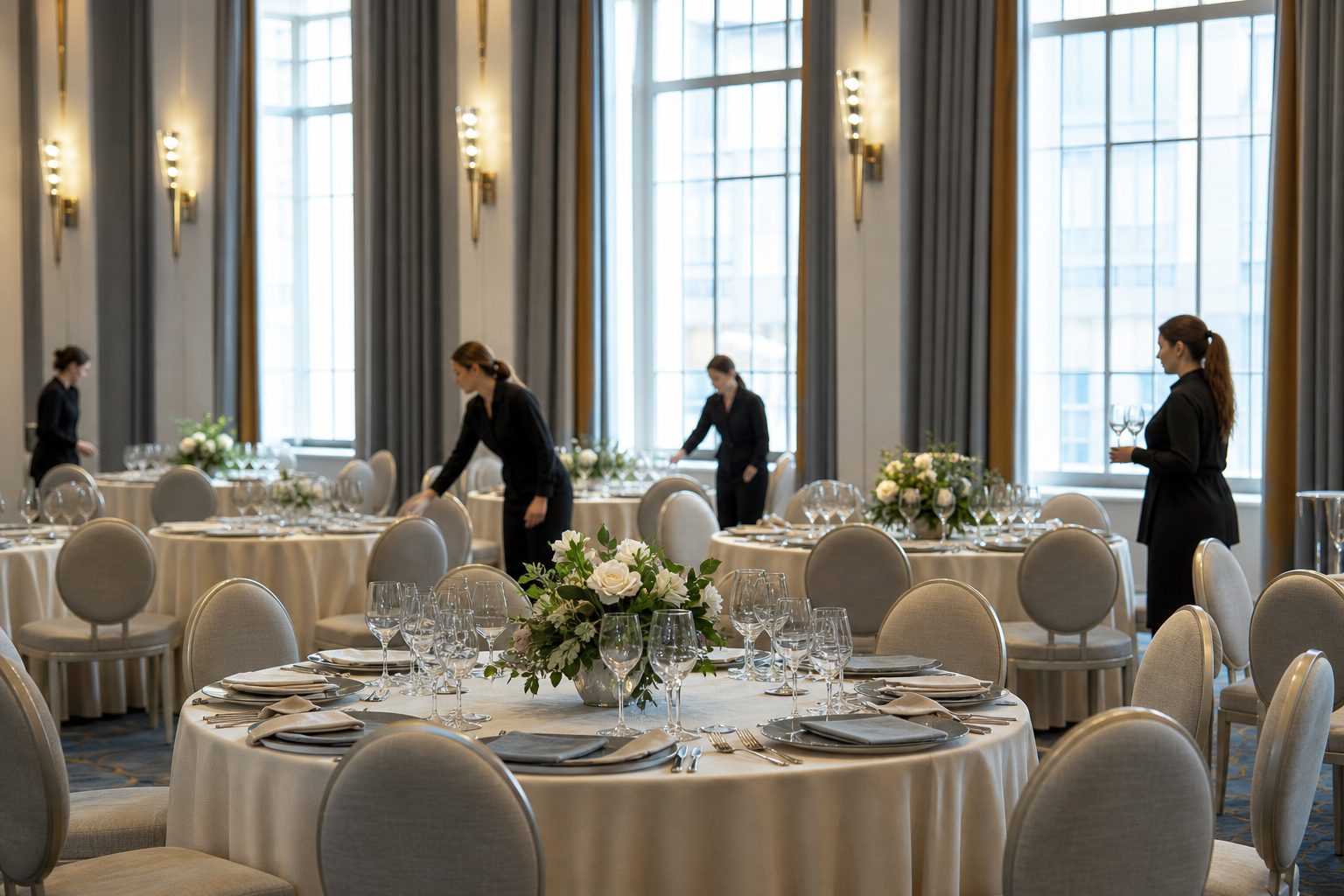
For one hundred fifty guests at a hotel or club, the honest planning range is roughly one hundred forty to two hundred twenty dollars per guest in direct cost before a dollar reaches the mission. The single largest driver is the food and beverage line, and the reason chapters miss their budget is almost never the entree price. It is the service charge and sales tax stacked on top of it, which routinely add thirty to forty percent to whatever number the catering sheet shows.
Run the arithmetic once and it stops being frightening. At an eighty five dollar per plate menu with a twenty two percent service charge and eight percent sales tax, your true food and beverage cost per guest is not eighty five. It is eighty five times 1.22, which is one hundred three dollars and seventy cents, times 1.08, which is one hundred eleven dollars and ninety nine cents. Multiply by one hundred fifty and the catering line alone is sixteen thousand seven hundred ninety nine dollars.
Every figure in this article is illustrative arithmetic from stated assumptions so you can substitute your own quotes. Nothing here is a survey result. The structure of the stack is what transfers, not the numbers.
Venue: food and beverage minimums versus flat rental
Venues price two ways, and the difference matters more than the headline number. A flat rental charges you for the room and lets you bring or select catering. A food and beverage minimum charges no room fee but requires you to spend a threshold amount on food and drink, and anything you fall short by is billed as a room charge anyway.
A minimum is not a discount. If a hotel quotes a fifteen thousand dollar food and beverage minimum, read carefully whether that minimum is measured before or after the service charge and tax. Most contracts measure it on the pre charge subtotal, which means your actual spend to clear a fifteen thousand dollar minimum is closer to nineteen thousand seven hundred dollars once you gross it up.
Contract clauses worth negotiating before you sign
- Attrition: what you owe if you guarantee one hundred fifty and deliver one hundred twenty
- Guarantee deadline: usually seventy two business hours out, and it is the number you pay on even if guests no show
- Overset: whether the venue sets a few seats above your guarantee at no charge
- Cake or corkage fees if you bring anything in
- Whether the service charge is taxable in your state, which varies and changes the total
Keep reading: What should I check before we hand the chapter books to the audit committee this year?
Per plate catering, service charge and tax stacking
The stacking order is the part that gets missed. Service charge applies to the food and beverage subtotal. Sales tax then applies to the subtotal plus, in many states, the service charge itself. That compounding is where budgets break.
| Line | Calculation | Amount |
|---|---|---|
| Plated dinner, 150 at $85 | 150 x 85 | $12,750 |
| Two hour hosted wine and beer, 150 at $28 | 150 x 28 | $4,200 |
| Subtotal | $16,950 | |
| Service charge at 22% | 16,950 x 0.22 | $3,729 |
| Sales tax at 8% on subtotal plus service | 20,679 x 0.08 | $1,654 |
| Food and beverage total | $22,333 |
One clarification that saves arguments with your board. A service charge is not a gratuity. It generally goes to the venue, and staff tipping may be separate. Ask directly whether gratuity is included or expected on top, and get the answer in the contract rather than in an email.
Audiovisual, rentals and decor
In house audiovisual is convenient and expensive, and most hotels have exclusivity clauses that prevent you from bringing your own vendor without a fee. For a gala with a program, a podium, a slide deck and a paddle raise, budget for a house sound system with two wireless microphones, a projector and screen, and a technician for the duration.
A workable planning figure for that package is two thousand two hundred dollars, with the technician's labor being the piece that surprises people. Then decor: centerpieces at thirty five dollars for fifteen tables is five hundred twenty five dollars, plus linens if the house linen is not acceptable, plus a photographer if you want images for next year's appeal.
The advice that actually saves money here is to cut quantity, not quality. Ten beautiful low centerpieces on fifteen tables looks intentional. Fifteen mediocre tall ones look like a budget compromise, and they block sightlines during the program, which costs you paddle raise revenue.
Event liability insurance and any liquor requirement
Nearly every venue will require a certificate of insurance naming it as an additional insured, typically at one million dollars per occurrence. If your chapter carries a general liability policy, this may be a certificate request at no additional cost. If it does not, special event policies are widely available and a single evening event of this size is commonly a few hundred dollars.
Liquor is the separate question. If alcohol is served by the venue under its own license, host liquor liability is usually covered by the venue and you should confirm it in writing. If you are serving alcohol yourself, at a rented hall or a private club, you will likely need host liquor liability added to your policy and possibly a temporary permit from your state alcohol authority. Do not assume a licensed bartender solves it. The permit and the coverage are different things.
If your gala includes a raffle, check your state's rules before you sell a single ticket. Charitable raffles are regulated at the state level, some states require registration or prohibit them outright, and the rules for a raffle are not the rules for a silent auction.
Keep reading: Is it worth moving our dues collection off personal payment apps this fall or not?
Printing, postage and ticketing fees
Print is a smaller line but it comes early, which means it hits the budget before ticket revenue arrives. For a one hundred fifty guest gala, a reasonable set is four hundred invitations with envelopes, a program for each guest, table numbers, bid sheets, and signage.
- Invitations and envelopes, 400 pieces: $700
- First class postage on 400 invitations at current rates: roughly $300
- Programs, 175 printed: $325
- Signage, table cards and bid sheets: $250
That is about one thousand five hundred seventy five dollars, spent sixty days before you hold the event. Cash timing, not just cost, is what makes this line worth planning. A chapter with four thousand dollars in the bank cannot float an eight thousand dollar deposit plus print costs, and that is where sponsorship prepayment becomes structural rather than nice to have.
Payment processing on tickets, sponsorships and the paddle raise
Card processing is charged on every dollar that comes in, and galas move a lot of dollars. At a common rate of 2.9 percent plus thirty cents per transaction, the arithmetic on a typical event is:
| Revenue source | Gross | Transactions | Processing cost |
|---|---|---|---|
| Tickets at $175 | $26,250 | 95 | $790 |
| Sponsorships | $15,000 | 8 | $438 |
| Paddle raise and auction | $18,000 | 60 | $540 |
| Total | $59,250 | 163 | $1,768 |
Nearly eighteen hundred dollars is a real line and it belongs in the budget from the start. Two practical mitigations: ask large sponsors to pay by check or ACH, which removes the percentage entirely on the biggest amounts, and offer guests the option to cover the processing fee at checkout. A meaningful share will, and it costs you nothing to ask.
See how ChapterDues handles this for women's membership chapters and alumnae groups
Setting the ticket price against your break even
Pull the lines together and you can price with confidence instead of by feel.
| Cost line | Amount |
|---|---|
| Food and beverage, fully loaded | $22,333 |
| Audiovisual and technician | $2,200 |
| Decor, linens, photography | $1,900 |
| Insurance | $500 |
| Print and postage | $1,575 |
| Payment processing | $1,768 |
| Total direct cost | $30,276 |
That is two hundred one dollars and eighty four cents per guest across one hundred fifty guests. If you price tickets at one hundred seventy five and sell all one hundred fifty, ticket revenue of twenty six thousand two hundred fifty dollars does not cover costs. The event breaks even only with sponsorship, and it produces mission money only with the paddle raise.
The decision rule: secure sponsorship equal to or greater than your fully loaded food and beverage number before you sign the venue contract. In this example that means fifteen thousand dollars committed in writing. If you cannot, the gala is a program expense wearing a fundraiser's clothes, and a smaller format will raise more.
The quid pro quo disclosure on tickets above deductible value
When a donor pays more than seventy five dollars and receives goods or services in return, the IRS requires the organization to provide a written statement telling the donor that the deductible amount is limited to the excess over the fair market value of what she received, and giving a good faith estimate of that value.
Applied here: a one hundred seventy five dollar ticket where the dinner's fair market value is eighty five dollars means the deductible portion is ninety dollars. Your ticket confirmation and your acknowledgment letter should say so plainly. Fair market value means what the dinner would cost the guest to buy, not what the chapter paid, so donated food does not reduce it.
Two edge cases worth knowing. A sponsor who receives no benefits beyond name recognition may be deducting the full amount, but if the package includes a table of ten, the value of those seats must be disclosed the same way. And auction winners are deductible only above the item's fair market value, which is why your bid sheets should print that value next to the item.
Before you commit to the room
Build the cost stack before you fall in love with a venue. Take the per plate quote, gross it up for service charge and tax, add audiovisual, insurance, print and processing, and divide by your realistic headcount. Then check the sponsorship rule. That one page of arithmetic prevents the outcome chapters dread, which is a beautiful evening that nets four thousand dollars for a scholarship fund after eight months of volunteer work.
ChapterDues handles the part that runs alongside the event: ticket and RSVP collection tied to the member roster, so you know who is current and who is bringing guests, with payments landing in the chapter's own records rather than three separate places. The treasurer sees what came in against what was budgeted while the event is still happening, and the following year's board inherits the numbers instead of reconstructing them.